

Phoenix, Arizona has recently broken the top ten largest cities in the United States, a product of its massive growth as a hub for the Sun Belt. People flock there from more crowded cities on the east and west coasts due to an abundance of cheap land, meaning cheaper housing, and of course, the weather. Averaging 7-8 inches of rain per year, it and Las Vegas the top spot for the driest major city in the country.
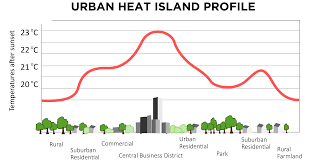
The urban heat island effect is when cities become warmer than surrounding areas due to a rising ground temperature. The massive, low-rise, sprawling city has an enormous footprint, all of which is paved using asphalt, which traps heat. Studies have been conducted in low and high income neighborhoods of Phoenix addressing the heat problem, and they found that poorer areas are, on average, ten degrees warmer than the higher-income areas. This is due to many middle and upper-class residents planting trees to mitigate the extreme heat, which includes upwards of 110 days per year over 100 degrees. Trees are costly in terms of water consumption, especially in a city with as little water as Phoenix. Many suburbs also feature green lawns, much like those in the rest of the country, which put further pressure on the already strained infrastructure.
In the coming years, the city could experience temperatures at and exceeding 125 degrees. In 2016, more than one hundred people died due to heat waves, and in mid 2025, a man sued the police for suffering third-degree burns when he was pinned down and arrested. His injuries meant he had to spend a month in a burn center. City officials passed a law saying that dog owners could walk them around town when the temperature was over one hundred degrees, since that can easily raise the sidewalk temperature sufficiently to burn their paws. The city also does not cool down at night, meaning it still can not be done after the sun sets.
While an extreme case, many popular areas in the United States are experiencing problems similar to these. The Sun Belt region has been steadily growing warmer, and the question is arising if it will remain safely habitable in the next twenty years. However, it is a region that has not faltered in its popularity, especially after Covid and the suburbs becoming vastly more popular due to remote work.
Winters in Indiana can be extremely harsh, but that may be something that people need in the future as southern states heat up in the wake of global warming.