
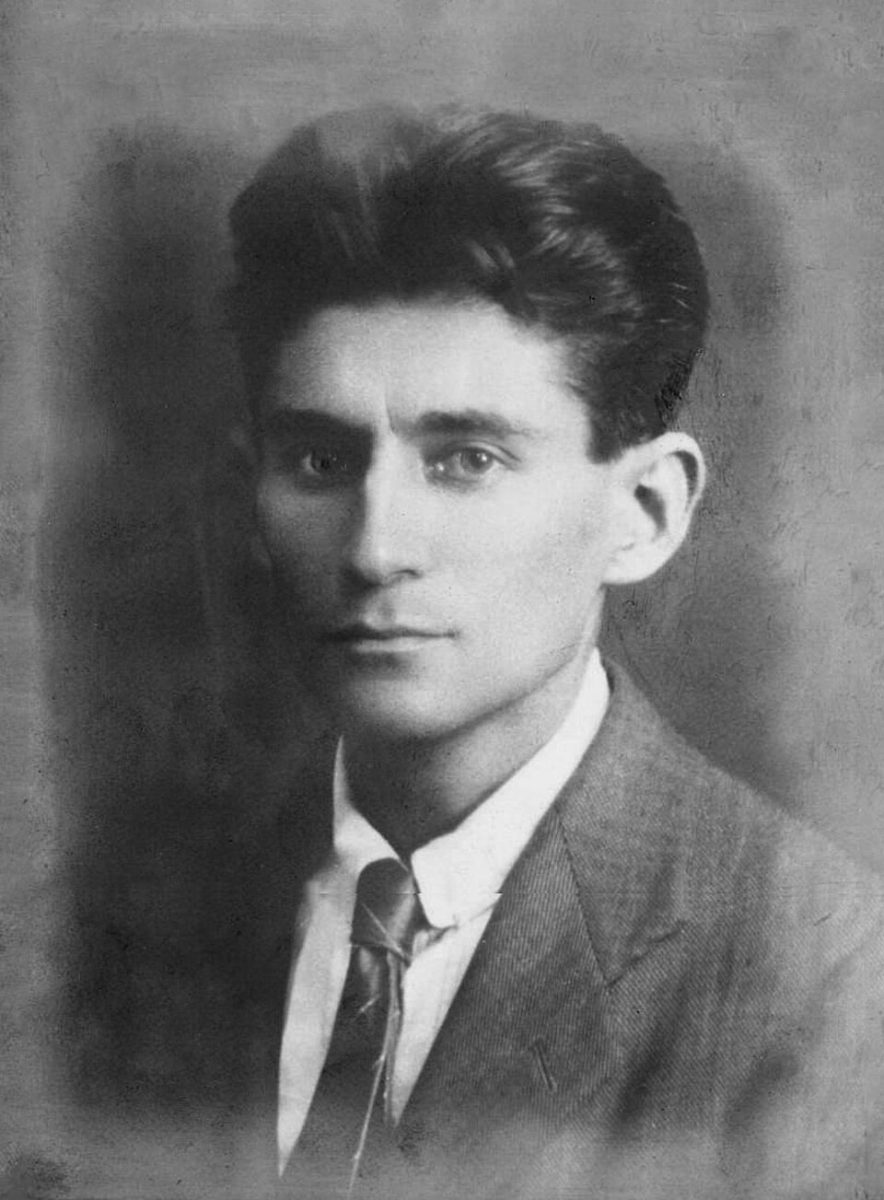
Franz Kafka was born in 1883 to a middle-class Jewish family in Prague, then part of the Austro-Hungarian Empire, today the capital of the Czech Republic. He had five siblings, two brothers and three sisters. Both brothers died before he was seven, and his three sisters were all murdered in the Holocaust after Kafka’s death. Despite having companions, he grew up a lonely child, alienated from his peers for both his Jewish heritage at a time of rising anti-Semitism and his status as a German speaker in a predominantly Czech area.
Kafka struggled with paternal issues throughout his entire life. His father, who built a successful business from the ground up, had a large influence on Kafka’s writings, taking the role of the strong, confident authority in contrast to Kafka’s own shyness and frailty. However, his father found himself unable to relate to Kafka’s literary work, wanting his son to instead follow in his footsteps and become a businessman. Kafka even went on to write a long letter about his emotionally abusive nature, describing how he was frightened of him, though it was never delivered. Nonetheless, Kafka thought very highly of his father, admiring his ability to push through the complexities of life.
He received a Doctorate of Law in 1906 and had one year’s experience of unpaid training as a law clerk. He later became employed at an insurance company and was rapidly promoted, though the long hours allowed no time for reading and writing. Kafka held his passion for writing in very high esteem, going on to write The Judgement in one sitting at the age of 29. He went on to describe the feeling of writing it as an opening of both body and soul, a type of death and rebirth. It was then that he fully accepted himself as a writer, though he wrote for personal enjoyment, fueled by his own compulsions and unaware of the global effects his work would have.
Though things were going well regarding his hobby, in his personal life, the same couldn’t be said. He had several unsuccessful relationships with women, suffered from severe social anxiety, and had low self-confidence, especially regarding his looks. Kafka suffered from frequent insomnia, migraines, and other ailments, which he attempted to fix with physical exercise and a strict diet. However, oftentimes, he contemplated suicide.
Regardless of how Kafka viewed himself, those around him described him as quiet, cool, intelligent, and with a charming sense of dry humor. Many saw him as boyishly handsome. Nonetheless, his appearance couldn’t hide the mental torment within. Psychologist Pérez-Álvarez claimed Kafka’s writings hinted heavily at schizoid personality disorder, though Alessia Coralli and Antonio Perciaccante, two Italian medical researchers, believe he may have suffered from psychopsysiological insomnia and borderline personality disorder. He burned roughly 90% of his work, calling it a “materialisation of horror” and believing the themes in his writing, which often focused on despairing characters, were unfit to be shared with the world.
In 1917, Kafka was diagnosed with tuberculosis and moved to live with his sister Ottla on their farm in Zürau, a period which is often cited as the best of his life. Kafka kept several notes and diaries during this period, which were published under the title The Zürau Aphorisms or Reflections on Sin, Hope, Suffering, and the True Way. In March of 1924, his tuberculosis worsened, and he was sent to Hugo Hoffmann’s sanatorium just outside Vienna on April 10th.
On June 3rd, he was pronounced dead. His apparent cause of death was starvation, as tuberculosis-induced throat pain made it painful and, eventually, impossible to eat. With no type of feeding tube invented, there was no way for him to be fed. In his last few days, he edited A Hunger Artist, spending his last moments doing what he loved: writing. He was buried in the New Jewish Cemetery in Prague-Zizkov.
Before his death, Kafka asked his dear friend Max Brod to burn his unpublished manuscripts of The Trial and The Castle. However, Brod was unable to fulfill his wishes. Though Kafka died relatively unknown and without an ounce of fame, Brod’s inability to burn his work, and instead eventual publication, made his name known, especially after World War II.
Today, Kafka is hailed as the defining author of modern existential anxiety, as his work describes personal alienation, growing elitist power, and the struggle of feeling lost in a chaotic, ever-changing world. The term Kafkaesque is even used to describe nightmarish, bizarre situations that often involve oppressive bureaucratic powers and inescapable prisons. Though he never would’ve guessed it, Kafka has become one of the most recognizable and beloved authors of the 20th century. If only he knew how much the world would’ve loved him, perhaps he wouldn’t have died believing himself to be a failure.