

In Missouri, especially the Branson area, trout fishing is a popular pastime amongst those who adore all things outdoors. Though the fish are not native to the area, they were gradually introduced in the 1880s by those seeking to take advantage of the Ozarks’ cold streams. They were imported from California and distributed by railroad. While initially sparse, today, Lake Table Rock alone is stocked with roughly 750,000 trout annually.
Rainbow trout, the first to be introduced, quickly became the most prosperous species and make up most of this number, though brown trout are what the region is most famous for. Due to the near-perfect conditions, they can grow to record-breaking sizes, making the area insanely popular for those looking to hit it big. However, laws ensure that brown trout aren’t driven to extinction, and fishers are only allowed to take one trout per day, as long as it’s 20 or more inches long, in contrast to the four rainbow trout of any size permitted by law. Though these populations are protected, someone has to keep them up, and one of those someones is the Shepherd of the Hills Fish Hatchery.
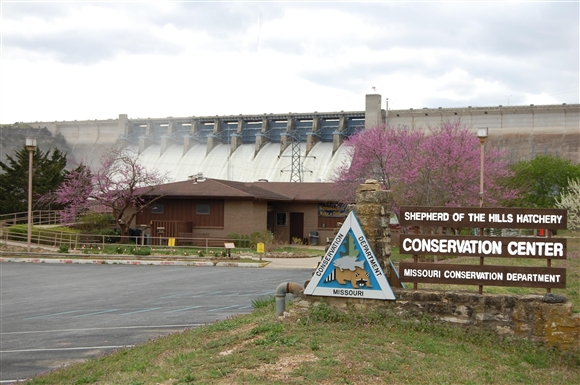
Branson’s Shepherd of the Hills Fish Hatchery and Conservation Center is the largest trout fishery managed by the Missouri Department of Conservation. Every year, it produces anywhere from 350,000 to 400,000 pounds of trout, with eighty percent being fed into Lake Taneycomo. The remaining twenty percent is distributed throughout the area. It’s located just below the Table Rock Dam, roughly six miles from Branson. The hatchery is excellently maintained and offers various activities to give you an hour or so’s worth of fun for little to no cost.
When you first enter, you’ll be greeted by the front desk, where dozens of fliers for local attractions and restaurants can be found. If you’re a Branson first-timer, these will be extremely helpful, so make sure to snag a few. Next to this desk is a reptile cage in which a two-headed western rat snake named Tiger Lily is kept. She was found in 2017 under a family’s deck and taken in by the conservation center. She’s the result of bicephaly, a condition that occurs when two conjoined twins don’t fully separate. Both heads can move independently and often attempt to go in different directions, complicating her movement. Workers feed both mouths separately, though they both share one esophagus. Just down the hall, you can see other native reptile species, these ones having no abnormalities, with information cards above.
Following the hall will take you to a small fish display where several rainbow trout are kept. These fish are humongous, with one even reaching a record-breaking length. Most are covered in small white spots from running into the glass or getting into fights, though some remain scarless. More information cards can be found around the exhibit.
Depending on what time you go, you may be able to catch the informative video played every half hour about the conservation center. It’s eight minutes long and details the beginning of trout fishing in Missouri, how the conservation center came to be, how the trout are bred, and how and where they’re released. You also may be able to catch one of the staff members giving a lesson on the native mammal species. If you approach, you’ll be able to feel an assortment of fur pelts, including skunk and fox, view some skulls, and learn about mammal sightings in the area. Remember, all of this is completely free!
Going outside, you’ll come across a large collection of trout pools, where hundreds of fish, all in different developmental stages, can be found. They’re protected by metal cages to prevent birds from snatching them up, and they’re constantly moving, creating a rippling effect on the water’s surface. The farther south you go, the sparser and larger the trout become. If you’re willing to pay a mere twenty-five cents, you can get a handful of fish food from a gumball machine to feed them through the bars. As someone who got a few handfuls, I would definitely recommend this experience. You don’t truly grasp how many trout are in the bed until they all rush for the food, slithering over one another in an attempt to snatch the pellets up first. All proceeds from these stations go right back to the conservation center to boost their efforts.
All in all, the Shepherd of the Hills Fish Hatchery and Conservation Center is a must-stop if you’re in the Branson area, especially if you’re looking for a low-cost activity in between tours or shows. It’s informative, cheap, quick, and leaves you considering if the region’s trout fishing may be your next hobby.