
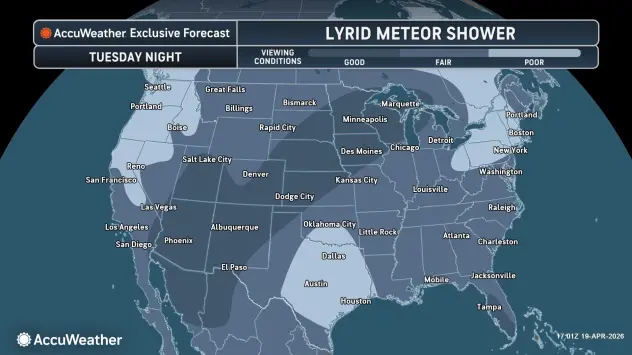
Every year, the Lyrid Meteor Shower graces our skies. It typically begins around the 14th to the 16th of April, and can be seen in the northeast, near the Lyra constellation and the Vega star. It lasts until April 29th, though the predicted peak occurs on either the 21st or the 22nd.
Most meteor showers are the result of debris from a passing comet. In the Lyrids instance, the meteors originate from Comet C/1861 G1 Thatcher, a cosmic body over 16 billion kilometers from Earth with a diameter between 6.2 and 12.4 miles. Its earliest record is from 1861, the time of its last perihelion (orbital point closest to the sun). For Thatcher, it takes approximately 415 years to circle the Sun, a path that brings it within Earth’s orbit, then shoots it billions of kilometers away. It’s predicted to reach its farthest point from the Sun in 2070 and reach our orbit again in 2278. That being said, neither you nor your children will witness Thatcher’s next appearance. However, you can witness sprinklings of it in the Lyrid Meteor Shower this month.
This shower occurs as Earth moves through Thatcher’s debris, and the tiny particles burn up in the upper atmosphere at speeds of around 30 miles a second. Their flaming bodies then create the beautiful streaks of light across the night known to us as meteors. During the peak day, 5 to 20 meteors can be seen every hour. Records of the Lyrids date all the way back to 687 BC in China, where astronomers described “stars [that] fell like rain”. For over 2,700 years, we’ve been admiring the show that space has put on for us every spring.
How can the meteor shower be seen? As stated previously, the best viewing place is in the Northeast, close to the Lyra constellation and the Vega star. From the northern hemisphere, Vega rises above the horizon at 9 or 10 p.m. local time in April, climbing up the sky through the rest of the night. By midnight, it’s high enough that meteors from that direction can be best seen streaking across the sky. The general rule of thumb is that the higher Vega appears, the more meteors you’ll witness. For those in the Southern Hemisphere, Vega doesn’t rise until early dawn and never rises to great heights. Most meteors come from a northern point, which, from the Southern Hemisphere, makes them appear below the horizon. Therefore, the viewing window for these meteors is extremely narrow, though it remains a possibility that you could catch a glimpse of a couple.
Though it’s highly recommended that you go out and witness the shower for yourself, if you prove to be unable, there are several videos of the Lyrid meteor shower on the internet. In fact, on April 21, 2012, astronaut Don Pettit focused his camera on Earth and captured footage of the shower’s peak from the International Space Station. The video has been linked below if you have any interest in viewing it. However, even if you miss it this year, the Lyrids will loyally return next April and surely put on just as spectacular a show.