

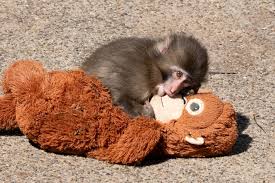
If you’ve been anywhere online recently, you’ve certainly seen media of an adorable Japanese macaque named Punch and his stuffed companion, but what’s his story? Why does the internet feel so connected to him?
Punch-kun, generally referred to as Punch, was born on July 26, 2025, in the Ichikawa City Zoo in Japan. He was named after Monkey Punch, the mangaka who wrote Lupin the III. Shortly after birth, his mother rejected him, a behavior that primatology expert Alison Behie attributed to age, health, and inexperience, seeing as she was a first-time mother. However, zookeepers also added that he was born during an extreme heatwave, creating an overwhelming and stressful environment. Oftentimes, in the face of such conditions, mothers will abandon their children to prioritize their own health and future reproduction rather than “wasting” materials on a baby who may succumb to these elements. Left without a parent, he was artificially fed from a bottle and raised by two zookeepers.
On January 19, 2026, at almost six months old, he was placed in the zoo’s exhibit with roughly 60 other macaques. Due to his lack of a maternal figure, Punch was noted to show “signs of anxiety and isolation”, though his perseverance indicated he had a strong mentality.
Several videos show Punch attempting to socialize and find his place among the troop, though each time, he’s chased off and ostracized. From the beginning, Punch’s journey to integration was destined to be a rough one. Mother macaques generally act as their baby’s guiding figure, protecting them from the strict hierarchy of the troop until they can find a role. However, without a mother and no proper socialization skills, Punch had no clue of the proper way to treat his higher-ups, creating conflict between those who were trying to put him in his place and the innocent desire for connection in his heart.
Seeing how much he was struggling, zookeepers gifted him a Djungelskog orangutan plush from IKEA, which he began treating as a surrogate mother. When abused by his troop, he quickly turned back to the safety of his plush, which quickly became his sole source of comfort.
As the weeks rolled by, Punch gradually began to assimilate into his group, even after the physical assaults and verbal conflicts. In late February 2026, an adult macaque took to protecting him, grooming his fur, and keeping him company. Punch’s integration had begun. He began to rely less on his caretakers, eating on his own and finding company amongst his kind. Even his plushie fell into the background as he connected with more and more of his species. In the last few days, videos and photos have gone viral of Punch socializing with a young female macaque named Momo-chan, the two of them snuggling and playing together. Just like with every baby, Punch has flown from his nest and found a new place and companion to call his home.
After the first article was posted on February 5, Punch became an internet sensation. The number of visitors to the zoo doubled. IKEA itself even acknowledged the story, sending the lonely primate 33 orangutan plushies.
Thousands of people found themselves sympathizing with the little macaque, causing the tag “#HangInTherePunch” to go viral. Punch symbolized the underdog, echoing humanity’s innate desire for connection and the sickening feeling that comes from rejection. Those with social anxiety felt especially connected to the innocent soul, relating to the feeling of finding comfort in an inanimate object to battle against the cruelty of society. However, Punch’s story also served as an inspiration to many. Despite being relentlessly bullied and rejected for weeks on end, Punch persevered. He kept trying to interact with the others, even if he had to retreat to the one “person” that accepted him, and his fighting paid off.
Eventually, the paw he reached out was accepted, and he was pulled into the troop. Punch’s story serves to show how continually reaching out to those around us, even if we’re initially slapped away, will lead us to meet our people. When it comes to socialization, we mustn’t give up on the idea of connection, since there’ll always be someone out there willing to take us in. Until then, we can turn to the one thing that provides us comfort, whether it be a person, a stuffed animal, or an activity.
He shows that, even if those who are supposed to love us will not, that does not mean we are unlovable. We can still find connection, whether it be in those around us or someone thousands of miles away. Somehow, one fluffy little warrior’s journey for connection managed to unite the globe.
Oh, Punch, you’ve no idea how much you’re loved.