

Throughout the centuries, medicine has taken many different forms. With the rise and fall of civilizations, new practices have emerged to replace old ones, sometimes for better and sometimes for worse.
Even today, medicine continues to evolve as research reveals unexpected long-term effects of substances previously thought to be helpful. However, none of them compares to some of the strange diagnoses and practices that have emerged throughout human history.
Wandering Womb
In Ancient Greece, many doctors believed that a woman’s womb was a separate entity with its own thought processes. As seen in the writings of both Hippocrates and Plato, it was believed that when a woman was celibate for a long stretch of time, her uterus could dislodge itself and glide freely throughout the body, resulting in seizures, hysteria, and suffocation.
To prevent this, women were advised to marry young and bear as many children as possible. Were it too late and the womb had already “wandered”, doctors prescribed infusions, massages, and therapeutic baths to try and force the uterus back into position.
In the 18th century, as understanding of human anatomy and biology advanced, it was discovered that the womb is incapable of moving throughout the body, and the theory was debunked.
Corpse Medicine
During the Roman Empire and for several centuries afterward, persistent headaches, muscle cramps, stomach ulcers, or practically any other ailment were “cured” with a nice prescription of human flesh, blood, or bone. The Romans believed that the blood of fallen gladiators held the ability to cure epilepsy, and 12th-century apothecaries usually kept a stock of “mummy powder”, an extract from ground-up Egyptian mummies, in their supplies.
Even in 17th-century England, King Charles II is remembered for drinking a brew of alcohol and crushed human skull known as the “King’s Drops”. Many of these practices were backed up by the existence of supposed magical properties, as when someone ingested the remains of a person, they ingested their spirit as well, which was believed to boost vitality and health.
The limb of cure was generally associated with the place of ailment (ex. skull for migraines), though it was difficult and gruesome to get a fresh stock. In some instances, sick individuals would attend public executions in the hopes of snagging a cup of fresh blood. However, use of corpse medicine faded by the late 19th century after doctors found that eating human remains was not only barbaric, but ineffective.
Trepanation
Trepanation is the earliest form of surgery, spanning Europe, North Africa, and the Americas, though it’s also the most gruesome. Dating back 7,000 years, humans would drill, scrape, or cut holes into the skull of an individual as a method to cure their illness. Researchers have no concrete idea of how this practice began, though many believe it was initially a tribal ritual or a method of releasing evil spirits that held back the mentally ill. Others believe it was a method of “healing” epilepsy, abscesses, and blood clots.
Peruvian skulls from early years hint that it was a common treatment for removing bone fragments from skull fractures, and, based on archeological evidence, it appears as though many patients survived. Today, trepanation is still practiced in rare, extreme cases to relieve intracranial pressure, access the brain for surgeries, or treat brain bleeding.
It’s referred to now as the “burr hole” procedure and utilizes sterile drills and small, precise holes rather than early, inaccurate tools and gaping wounds.
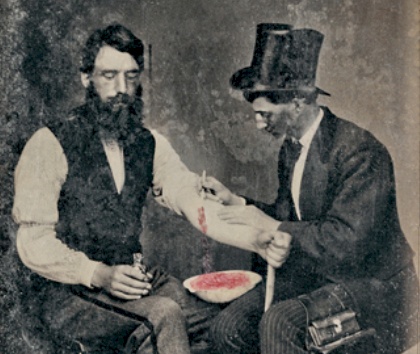
Bloodletting
For thousands and thousands of years, doctors believed that sickness was the result of “bad blood”, leading to the rise of bloodletting. Though it’s probable it was present in the time of the ancient Egyptians and Sumerians, it didn’t become a common practice until the time of Greece and Rome.
Physicians such as Hippocrates and Galen hypothesized that the human body was filled with four basic substances known as “humors”: yellow bile, black bile, phlegm, and blood. To maintain proper health, your humors needed to be in order. Therefore, when a patient was diagnosed with an ailment such as a fever, it was deemed to be the result of having too much blood.
To restore balance, doctors would either cut open a vein and drain blood into a receptacle or use leeches to suck the blood straight from the skin. Though it could easily result in death from blood loss, it continued through the 19th century, being prescribed for anything from a sore throat to the plague.
At some places, barbers would offer it as a service alongside a shave or a haircut. Eventually, it faded from prominence as research proved it to be more harmful than helpful, though, in extreme cases, leeches and controlled bloodletting are used for rare diseases such as haemochromatosis.