
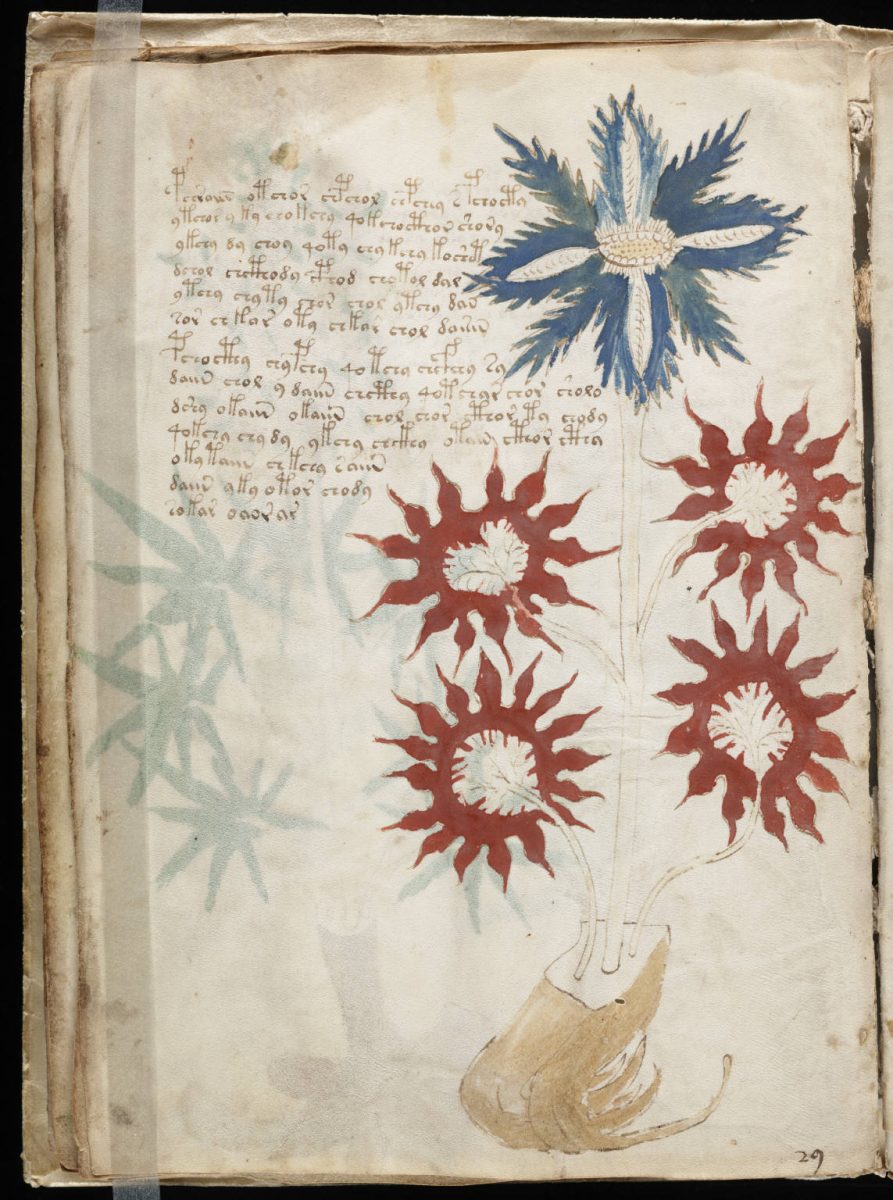
In 1921, Dr. Wilfred M. Voynich, a book dealer from London, began touring the US with a mysterious two-hundred-plus page manuscript, one he claimed would change the scientific world. The text, which went on to be known as the Voynich Manuscript, at first appears to be the notes of a typical medieval alchemist, though upon closer examination, the book proves unreadable.
Why? It’s written in an unknown language, one we’ve yet to decipher.
The book itself looks like a standard paperback novel, with its dimensions 6.2 by 8.8 inches. It lacks a table of contents, yet is broken down into six sections. The first, the “herbal” section, takes up nearly half the manuscript and features various drawings of plants. The “astrological” section shows intricate drawings of suns, moons, and stars, yet the constellations presented are unrecognizable.
The “zodiac” section appears relatively normal, yet the order of the signs is sometimes switched. The “biological” section puzzles decoders the most, as it appears to portray human organs populated by nude women bathing in pools of greenish water. Some believe these pools are simply natural hot springs with supposed healing properties; others believe something more sinister and nonsensical is presented. The “pharmaceutical” section shows drawings of cylindrical jars with various herb and root combinations. Lastly, the “recipes” section contains 300 short paragraphs, each with a star-shaped symbol at its side. For all we know, they may not even be recipes at all.
Though the manuscript came to fame in 1921, it’s been examined since the 17th century, when many believed it to be an encrypted text. Encoded letters and manuscripts were common in the medieval period, especially when it came to political figures attempting to protect state secrets, yet many of these were simple to crack, as they often utilized simple substitution. If the Voynich Manuscript proves itself to be a cipher, then it is the most complex cipher to ever exist in both modern and medieval times. As the writing appears to use a real alphabet with letters and words, a simple substitution method definitely isn’t the answer. Scholars can’t even agree on how many letters and symbols there are, with some saying thirty-four, and others saying seventy.
Some believe the manuscript is written in a language entirely its own. The manner in which the words are distributed matches the word distribution of modern languages. For example, some word clusters appear only in the “herbal” section, and others only in the “zodiac” section. In the 1940s, William and Elizabeth Friedman, two prominent codebreakers who had deciphered Japan’s “Code Purple” in World War II, determined it was an invented language. However, the time of the “invented language craze” swept Europe in the 17th century, meaning the manuscript’s dating of the 15th century makes the theory unlikely.
No matter how many theories are presented, skeptics will always remain. Many people believe that the Voynich Manuscript is a medieval hoax. As it is now and will always be, people love to rip each other off. Handwriting analysis suggests that five different individuals contributed to the text, which makes it possible that they collaborated to publish a collection of fake knowledge, guarded by their own “language”. On the other side of the pendulum, skeptics of modern science believe that it’s actually an alien guidebook left behind by an ancient visitor, giving us unlocked knowledge of our world.
Though the manuscript has been examined for more than 500 years, humanity has yet to find an answer. It remains a possibility that we’ll never know the truth behind the Voynich Manuscript, and the only people with knowledge of its secrets will remain those who made it, whether they be human or extraterrestrial.