
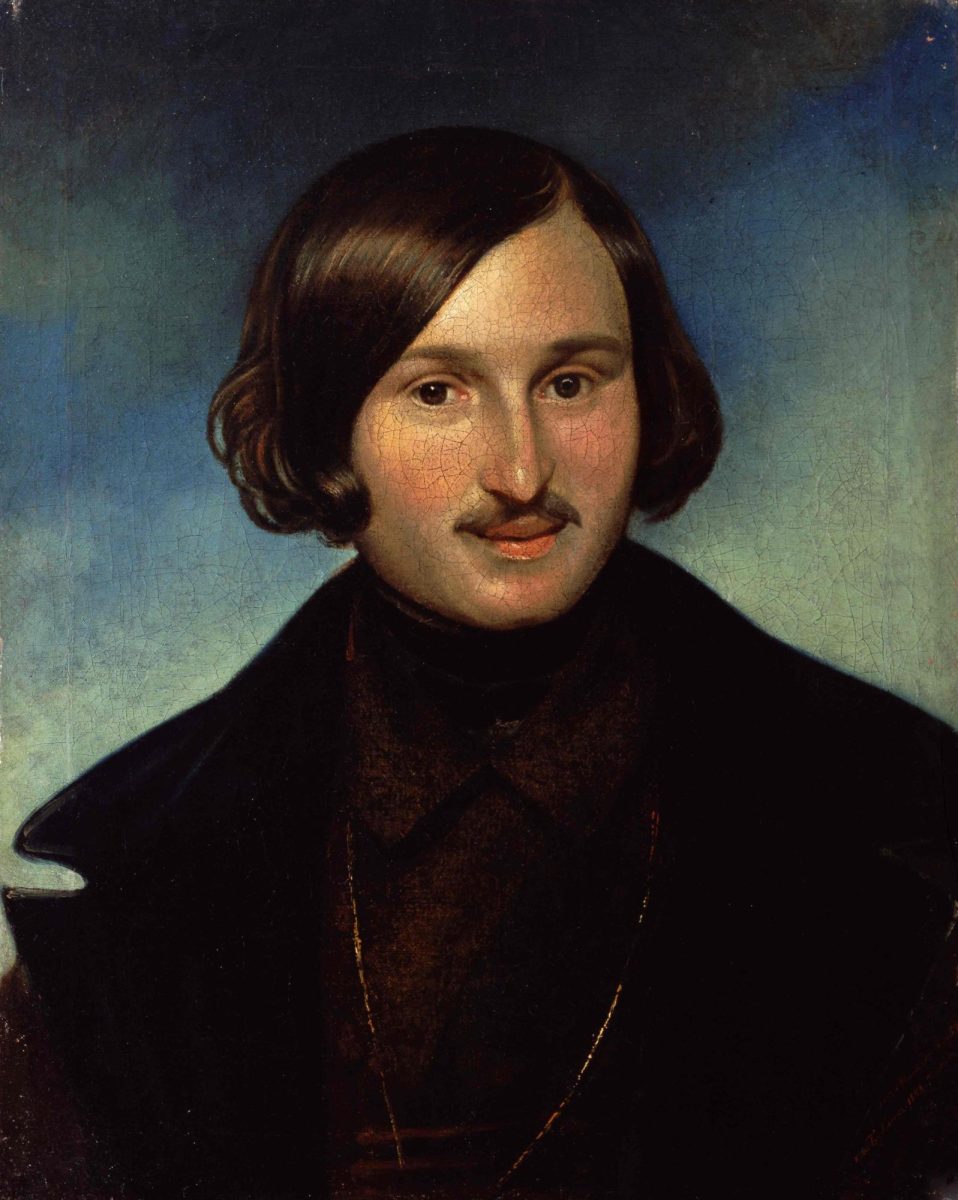
Nikolai Gogol, the author of Dead Souls and other short stories, was born in Sorochyntsi, a Ukrainian village, on March 19, 1809.
As a young boy, he knew he’d become famous, though he felt he was surrounded by people who “merely vegetate”. Gogol was a fan of laughter; nonetheless, he quickly gave way to depressive episodes due to his lack of friends and the death of his father at 16. He attended the Gynasium of Higher Sciences in Nezhyn from 1820 to 1828, where he was also terribly unpopular and titled the “mysterious dwarf”.
Perhaps due to his lack of popularity, Gogol developed a twisted nature, one built on self-consciousness and ambition. While there, he developed a love for both mimicry and writing, though the latter was the only career of his that ever took off. Upon leaving school, he published a long poem titled Hӓns Kuchelgarten, which chronicled the tales of a German adventurer. He sent copies to multiple literary journals, though his work was rejected and criticized by each one. Dejected and furious, he burnt every copy and swore never to write poetry again.
Keeping true to his promise, yet unable to give up writing, he switched to prose, publishing a collection of comedic, sentimental, and often morbid short tales under the title Evenings on a Farm Near Dikana. Unlike his poem, the stories were quite successful, introducing Gogol into the world of Russian literature.
He was acquainted with fellow Russian literati Vasily Zhukovsky, Pyotr Pietnyov, and Alexander Pushkin, the latter of whom he formed a close friendship with. Gogol, now finding some success in his work, went on to publish many other works, including Diary of a Madman, Nevsky Prospekt, The Nose, and The Overcoat.
His publications began to gradually explore more themes of isolation, bureaucratic criticism, and mental instability as he himself fell deeper and deeper into the torment of his own mind. After the death of his dear friend Pushkin, he produced the first section of Dead Souls, which appeared in Moscow the next year under the title The Adventures of Chichikov. Though some of his short stories gained popularity, it was this epic that established his place as a top-tier Russian prose writer. However, in his personal life, Gogol had yet to find any happiness.
Gogol regularly suffered from writer’s block, admitting in Author’s Confession that “several times…I took up my pen forcing myself to write a short story or any other literary work, but I could not produce anything”. Gogol’s irritation seemed rooted in the public’s view of his work, as many saw Dead Souls as an attack on the tsarist system, one he deeply believed in. Determined to fix what he’d done, Gogol became certain that the last two parts of Dead Souls could fix what he’d done through the main character’s spiritual purification, a symbol that Christian ideals could save his country. However, Gogol burned his work in the summer of 1845 to begin anew and instead published Selected Passages from the Correspondence with My Friends, an essay collection regarding his opinions on politics, religion, and literature.
Contrary to what he’d expected, the book was met with an uproar. Critics hated him, his political supporters turned against him, and he was deemed a fool. The depressive episodes he’d been prone to only became more common, and soon, Gogol was convinced he had some imaginary illness. Frantic to cure himself, he rushed about Europe, even taking a pilgrimage to Jerusalem, though he remained plagued. His last hope was a Rzhev priest named Konstantinovsky, who told him to abandon his work and enter a monastery. Gogol, broken and out of his head, replied, “Not to write means the same to me as not to live”.
And he meant every word.
On the night of February 12, 1852, Gogol burnt all his work on the second part of Dead Souls, a symbol of his own destruction. As the fire raged on, he sentenced himself to death, lying in bed and refusing food for nine days. By the time that doctors arrived, he was beyond saving, and died in agony on February 21, 1852, only a month before his forty-third birthday. His career spanned only eleven years, and he died believing himself a failure. However, history would prove otherwise; he was deemed one of the best Russian authors, and his work would go on to influence other greats, such as Fyodor Dostoevsky.