
Over fall break, I ventured out to Cincinnati to spend a weekend in the city.
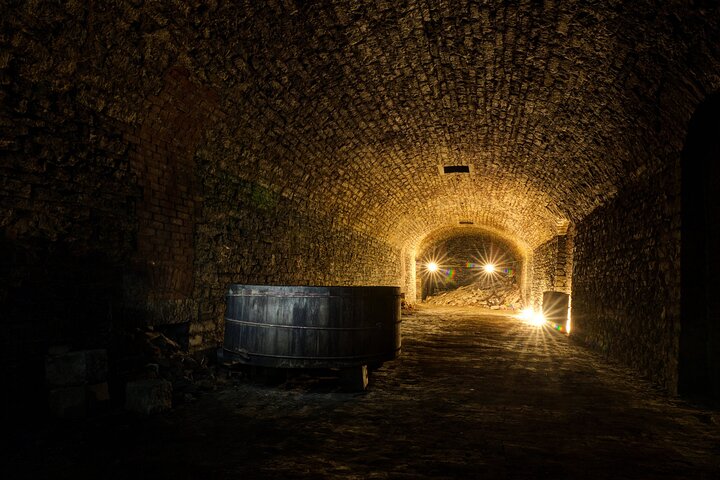
While there, I took the Nightmare on Elm Street Tour, provided by American Legacy Tours, which took us through the Over-the-Rhine neighborhood on the city’s outskirts. Our tour guide led us along Elm Street, beneath a local bar, and then underneath a city building to a set of four long-abandoned distillery tunnels.
While wandering along the concrete roads, doing our best to avoid the large street rats and protect our bodies from the autumn winds, we were educated on the dark history Cincinnati does its best to hide.
To begin, the city was the home of the first Ohio woman to be executed by the electric chair: Anna Marie Hahn. Hahn had lived in Bavaria for the entirety of her youth, though when she turned 19, she became pregnant with her son Oskar out of wedlock. Her family, seeing her as a disgrace, sent her to the US in 1929. She set up a residence in Cincinnati with her relatives, where she met and married fellow German immigrant Philip Hahn only a year later, who wished to help her start a family.
However, Hahn had more sinister ideas in mind. She began poisoning and robbing elderly German immigrants, supposedly to support her gambling habit. She would begin by sneaking a smidge of arsenic into their drinks, just enough to make them sick. Then, after they “suddenly fell ill”, she’d cure them, making her appear as a miracle doctor. Hahn would poison and cure her victims twice, enough to gain so much trust that she would have them put her in her will, before killing them. By the time she was caught, she had five confirmed victims and had stolen at least $33,000, a car, a house, and expensive furniture. Once caught and convicted, she was sentenced to the electric chair and died in the Ohio Penitentiary on December 7, 1938.
Cincinnati was also the stalking grounds of the Cincinnati Strangler from December 1965 to December 1966. Known by the legal name of Posteal Laskey Jr., he would choose female victims between 31 and 81 living in the city’s house complexes. As a taxi driver, he would drive the women to work and back and/or out to run errands. Oftentimes, his victims were found strangled with their own pantyhose. At the time of his capture, he killed seven women, six of whom were over fifty. Police were able to recognize him based on his taxi number, which was reported by an attempted victim. Laskey was then convicted of first-degree murder and sentenced to death in the electric chair. However, his sentence was changed to life imprisonment after his lawyers insisted the case’s publicity didn’t allow for a fair trial. He spent the rest of his life moving around different penitentiaries before dying on May 29, 2007, at the age of sixty-nine.
The story I find to be the most interesting of those about serial killers roaming Cincinnati is that of H. H. Holmes, the man considered to be America’s first serial killer. Known as the Devil in the White City, Holmes committed most of his crimes in Chicago, where he ran the infamous “Murder Castle”, a three-story building he advertised as a hotel. Once people had checked into their rooms, he would subject them to various modes of torture, moving through the walls to view their anguish from afar. As a doctor, he was eerily educated in human anatomy and used the hotel’s guests as his test subjects. However, once detectives began to catch on, he came out to Cincinnati in an attempt to evade them. There, he took three children from the local schoolhouse, a building you can still visit today. According to our tour guide, they found pieces of the boy he took in the chimney of his Indianapolis home, and the girls were found in the cellar of his Toronto residence. When Holmes was eventually caught, he confessed to 27 murders, though at his execution, he cryptically told the judge, “twenty to two-hundred”. To this day, no one is sure how many people Holmes truly killed.
Holmes was executed by hanging on May 7, 1896, remaining calm and unruffled all the way up until his death. He requested that he be buried under concrete, ten feet deep, so his body couldn’t be stolen by body snatchers and used as a cadaver. His request was accepted, and after his execution, he was buried in an unmarked grave at Holy Cross Cemetery in Pennsylvania. Holmes’ death took over fifteen minutes, as the drop from the podium didn’t break his neck. For a grueling quarter of an hour, he slowly strangled to death, twitching and hanging until he finally fell still and was pronounced dead. A gruesome, merciless death to make up for his terrible, monstrous actions.
However, darkness doesn’t only lie above ground. Beneath the city, in the dark distillery tunnels, ghosts are rumored to wander through the stone walls. While down there, our tour guide told us that the latter three tunnels held a “positive energy”, while the first tunnel, one hidden behind the staircase, was “full of evil spirits”. In the never-ending darkness, she led us throughout the middle two, telling us stories of a man named Harold who loved to tease and flirt with women, a girl named Catherine who loved the color blue and still hadn’t named her doll, and her younger brother Jonathan. While our divinity rods, rods supposedly used by the dead to communicate with us, did move back and forth in accordance with the questions asked (ex., cross them as a yes, keep them still for a no), and parts of the tour sent a chill down my spine, I remain a skeptic. Nonetheless, many Cincinnati residents believe victims of its sinister history haven’t quite abandoned their home.