

On August 23, I went to Crown Hill Cemetery in an attempt to find the grave of Ben Davis for the Spotlight Legacy Issue. On the way to find his grave, I came across the tombs of many other interesting individuals.
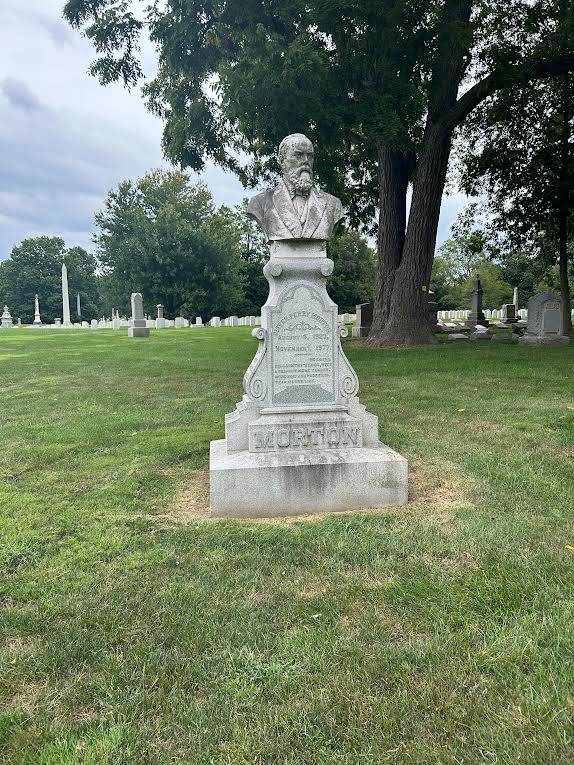
To begin, I found the grave of Oliver P. Morton, the first Indiana-born man to hold the governor’s office. He was one of the organizers of the Republican Party and began his personal political career in 1856 with an unsuccessful run against Ashbel Willard.
Four years later, he was elected lieutenant governor and succeeded to the governorship in 1861. He is best known for his role as wartime governor of Indiana during the Civil War, where he served diligently.
It is said that, immediately after Lincoln called for troops, Morton raised six thousand men and never failed to meet any of the following calls. At one point, when legislature failed to provide bonuses and advanced pay for troops, Morton personally raised $500,000 to fund their pay himself. Today, he is known as “The Soldiers’ Friend” due to his never-ending material support of Hoosier troops. He was re-elected in 1864 and served until 1867, when he was elected to the Senate. He served as a leading Republican until he succumbed to stroke complications in 1877.
I also found the grave of poet James Whitcomb Riley, who is known for works such as “Little Orphant Annie” and “The Raggedy Man”, amongst others.
Called the “Hoosier Poet”, Riley spent much of his youth drifting between jobs, having quit school at 16. However, he soon found success in poetry, with The Indianapolis Journal and The Anderson Democrat publishing his work.
He briefly ran into an issue after a controversy where he tried to pass off his work as a long piece by Edgar Allen Poe, though his career picked up once again when he partook in a traveling lecture circuit and began performing his poetry throughout the Midwest.
For 25 years, he performed across the nation and for each elected president. However, his nationwide popularity and tours didn’t prevent him from staying true to his Hoosier roots.
He was known for his use of the Hoosier dialect and, despite having many opportunities to move out of Indiana, he remained in his home state until his death on July 22, 1916, when he died in his house on Lockerbie Street. Today, you can go visit the home of the “Hoosier Poet”, whose works went on to inspire the creation of the musical Annie and the Raggedy Ann dolls.
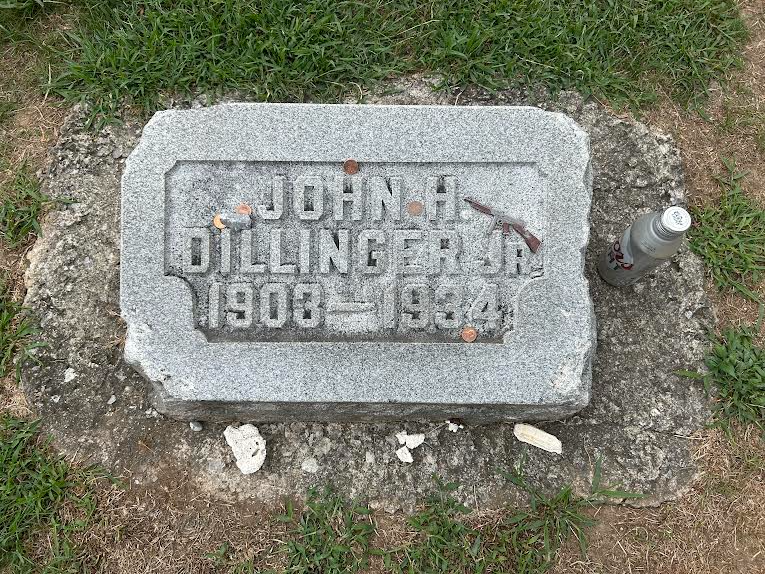
Lastly, I found the grave of John Dillinger, a notorious American criminal from the Great Depression era.
Though he was born in the city, he spent much of his youth in Mooresville, where he engaged in petty theft, bullying, and regular pranks.
His mother had died shortly before his fourth birthday, and his father, who believed strongly in disciplinary action, remarried six years later, leading to a deep-rooted resentment in the heart of young Dillinger.
At the age of 16, he dropped out of school and worked at a machine shop for three years until he partook in car theft.
To avoid prosecution, he enlisted in the Navy and served on the U.S.S. Utah, which would later sink during the attack on Pearl Harbor. Due to disciplinary issues, he was discharged after only a few months and returned to Indiana. In 1924, he attempted to rob a grocery store in Mooresville, leading him to spend almost an entire decade in prison.
When he was released on parole in 1933, he set off on a bank-robbing spree. He began in Lima, Ohio, moving throughout the Midwest as he robbed bank after bank. However, his doom would come 14 months later, when he was shot and killed by the FBI outside of a Chicago movie theater.
His death, much like that of other American gangsters, was quite the public spectacle. Many people who passed by his body dipped their handkerchiefs, skirts, and scraps of newspaper into his blood. His corpse was soon identified by his sister and, a few days later, was buried in Crown Hill Cemetery alongside the family tombstone.
By the time of his death, he had stolen roughly $500,000 and killed ten men, wounding seven others.