
January 30, 1925- The Day of No Return
Deep beneath the Kentucky soil, 60 feet from the light of day, a man becomes stuck in the earth. His name? William Floyd Collins.
Collins is 37 years old, a Kentucky native. From a young age, Collins had an interest in exploring caves and, just a few years prior in 1917, he discovered Crystal Cave beneath the family farmland. After its discovery, Collins developed it into a tourist attraction. At that time, cave discovery was a competitive business, with all kinds of men looking to find their fortune beneath the surface.
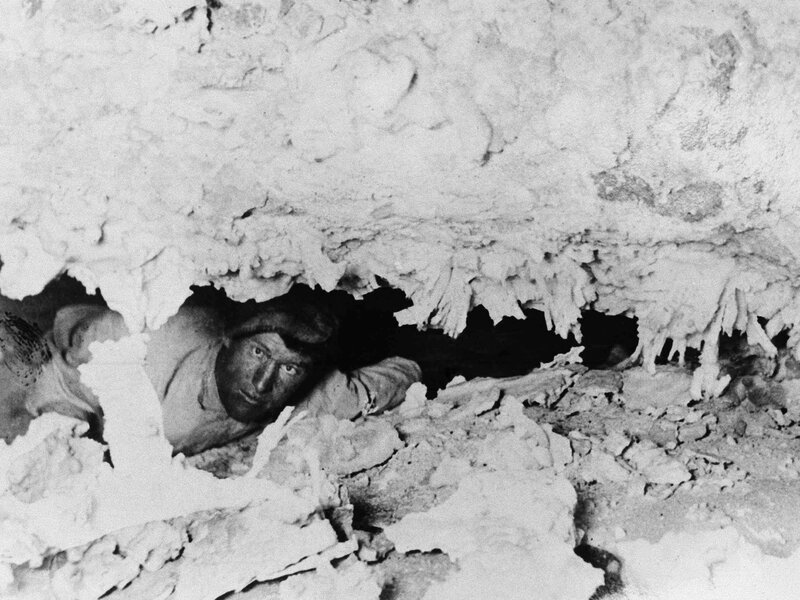
For Collins, that fortune was to be found in Crystal Cave, though the attraction didn’t get much foot traffic due to its remote location. Determined to find the cave of his dreams, Collins set out to the rumored Sand Cave just eight miles away. With only a singular kerosene lamp and his courage, Collins entered the passageway, an area rumored to be only twenty-five centimeters wide and forty-six centimeters high. He traveled through a long tunnel of tight turns and small squeezes, eventually reaching a depth of sixty feet. However, just as the cave opened up, his lantern began to flicker.
Out of fear of losing light, Collins reluctantly turned around and began the perilous crawl back. However, as he slid back through the cave, his foot dislodged a rock, weighing almost twenty-seven pounds, and kept his ankle in place. In such a tight tunnel, moving the rock proved impossible. Collins was stuck, all alone, with nothing but the earth to keep him company.
The next day, neighbors began to worry when he didn’t arrive home. After a quick investigation, Collins’ condition was soon revealed, prompting a large, multi-day rescue attempt. At first, his brother Homer attempted to dig him free, though this proved futile. For the first day, rescue attempts were chaotic and disorganized. Though people went down to give him food, they became too scared to venture any further and left supplies far from him.
Collins’ condition was starting to deteriorate as he went in and out of stupor episodes. His story began circulating throughout the state of Kentucky and eventually spread nationwide. This widespread circulation led to a large crowd camping outside of Collins’ prison. Rescuers soon started to put together organized attempts to get him out, though it quickly became evident that any wrong move could kill him. While they considered the best course of action, volunteers sent an electrical cord with light bulbs down to Collins to keep him warm and give him light. By the end of the day on February 3, most of the rubble was off his body, though he remained trapped.
The next day, Collins’ situation turned for the worse. Due to the movement of the crowds, the natural deterioration of the cave, and the prolonged periods of rainfall, the cave collapsed. The entryway was blocked, cutting off all connection between Collins and his rescuers. Any attempt to clear away this rubble would only result in more rockfall. Rescuers, now desperate, decided to dig a parallel rescue shaft down to Collins. Seventy-five men worked around the clock to dig it, and at a rate of 2 feet per hour, it is estimated that it would take thirty hours to reach him. However, by the time Collins had been in the cave for a week, the shaft was only seventeen feet deep. Two days later, they only managed to dig six feet deeper. The rockfall has cut off all communication with Collins. No one knew if he was dead or alive. Temperatures slowly began to dip into the twenties. The constant rain turned into snow. As the work progressed, the days Collins had been stuck only increased. Twelve…thirteen…fourteen…He hadn’t eaten in over a week. Water filled up the cave shaft. Desperate rescuers had to fight the slumping walls and pump out the water as they dug deeper and deeper. Forty-eight feet…fifty-two feet…fifty-five feet…until eventually…
Boom, they struck him.
February 16, 2025- Collins had been in the cave for 17 days.
At 1:30 p.m., rescuers finally broke through to Collins. What did they find? A dead man. Collins died in the dark, alone, starving, and cold. The cause of death was later determined to be exposure, exhaustion, and starvation. Based on the body’s condition, he’d been dead for roughly twenty-four hours. With his leg still stuck and conditions poor, rescuers decided to leave his corpse where it is. They saw no point in risking more lives for a man who was already gone.
Months later, Collins’ brother, Homer, rallied a group of people to dig a separate tunnel to rescue his brother’s corpse. It didn’t seem right to leave him in such a depressing tomb. Recovering his corpse and revealing him to the light of day, Collins was moved to the family cemetery. However, only two years later, his body was dug up and exhumed, used as a sort of twisted tourist attraction for Crystal Cave.
It wasn’t until 1989 that the morbid fascination died down, and out of respect for the family and Collins himself, he was buried at Mammoth Cave Baptist Church Cemetery, only 5.1 miles from his death site. Though the trail to Sand Cave remains, the cave is permanently closed to visitors due to safety concerns. However, through the brush, you can still see the fated tunnel where a thirty-seven-year-old man entered, blissfully unaware that he would never see the light of day again.